
When Glass Is Not Enough: Sapphire Photonic Crystal Fibers for Sensing at 2000°C
Research & Technology/ Precion with Light. Co-written by Nuno Edgar Nunes Fernandes, 12th May 2026.

A new IEEE Photonics paper from a Chinese-Oxford collaboration solves a fabrication problem that has blocked practical deployment of extreme-environment fiber sensors for years — and it does it by writing a photonic crystal structure directly into sapphire with a femtosecond laser.
The Wall at 1000°C
This publication has spent considerable time on photonic crystal fibers — their hollow-core variants guiding light through air with near-zero loss, their anti-resonant designs achieving 0.00088 dB/km confinement loss, their gas-filled configurations sensing trace molecules at parts-per-billion concentrations. All of that work has one thing in common: it is built on silica glass.
Silica is the foundation of modern fiber optics for good reasons. It is transparent across a wide wavelength range, it can be drawn into fiber with extraordinary geometric precision, and it is cheap. But silica has a hard ceiling: above approximately 1000°C, the glass softens, the dopants that define the refractive index profile diffuse, and the fiber’s optical and mechanical properties degrade irreversibly. A standard Fiber Bragg Grating inscribed in a germanosilicate fiber — the workhorse of structural health monitoring, strain measurement, and industrial temperature sensing — begins losing its grating structure well below that ceiling.
For most sensing applications, 1000°C is more than sufficient. For the environments where sensing matters most — jet turbine combustion chambers at 1400°C, industrial furnace interiors at 1600°C, advanced materials processing at 1800°C, aerospace propulsion monitoring approaching 2000°C — silica fiber is simply not an option.
The excellent optical transparency, thermal and chemical stability, mechanical robustness, and high melting temperature (~2040°C) of single-crystal sapphire fibers make them a strong candidate for sensing applications in high-temperature environments. Sapphire — aluminium oxide, Al₂O₃, in its single-crystal form — is the material that picks up where silica fails. Its melting point is nearly 1000°C higher than silica’s. It is chemically inert in oxidising and reducing atmospheres. It does not soften, it does not devitrify, and it does not lose its crystalline structure at temperatures that would destroy any glass-based alternative.
The challenge is that sapphire is not silica. You cannot draw it into fiber using a conventional draw tower. You cannot dope it to create a refractive index contrast. You cannot inscribe a Bragg grating using the UV photosensitivity that works effortlessly in germanosilicate glass. Working with sapphire fiber requires a completely different fabrication toolkit — and the paper published to arXiv on May 5, 2026, from a team spanning Chinese institutions and the Oxford Nanophotonics group, represents the most complete solution to that fabrication challenge demonstrated to date.
What Makes Sapphire Fiber Different — and Difficult
Before examining the paper’s specific contribution, it is worth understanding precisely why sapphire fiber sensing has been difficult to commercialise despite its obvious material advantages.
A conventional silica fiber achieves single-mode guidance through a simple refractive index step: the germanium-doped core has a slightly higher index than the pure silica cladding, and total internal reflection confines the light. The index contrast is small — typically 0.3–0.8% — which is sufficient because the core diameter is small and the guidance is tight.
Sapphire fiber, as grown by the laser-heated pedestal growth (LHPG) or edge-defined film-fed growth (EFG) methods, has no cladding. It is a pure sapphire rod, typically 75–250µm in diameter, with no index contrast structure. Light propagates through it, but in a highly multimode fashion — dozens or hundreds of spatial modes coexist, each with different propagation velocities, making coherent sensing signals difficult to interpret. The fiber acts more like a light pipe than a waveguide in the photonics sense.
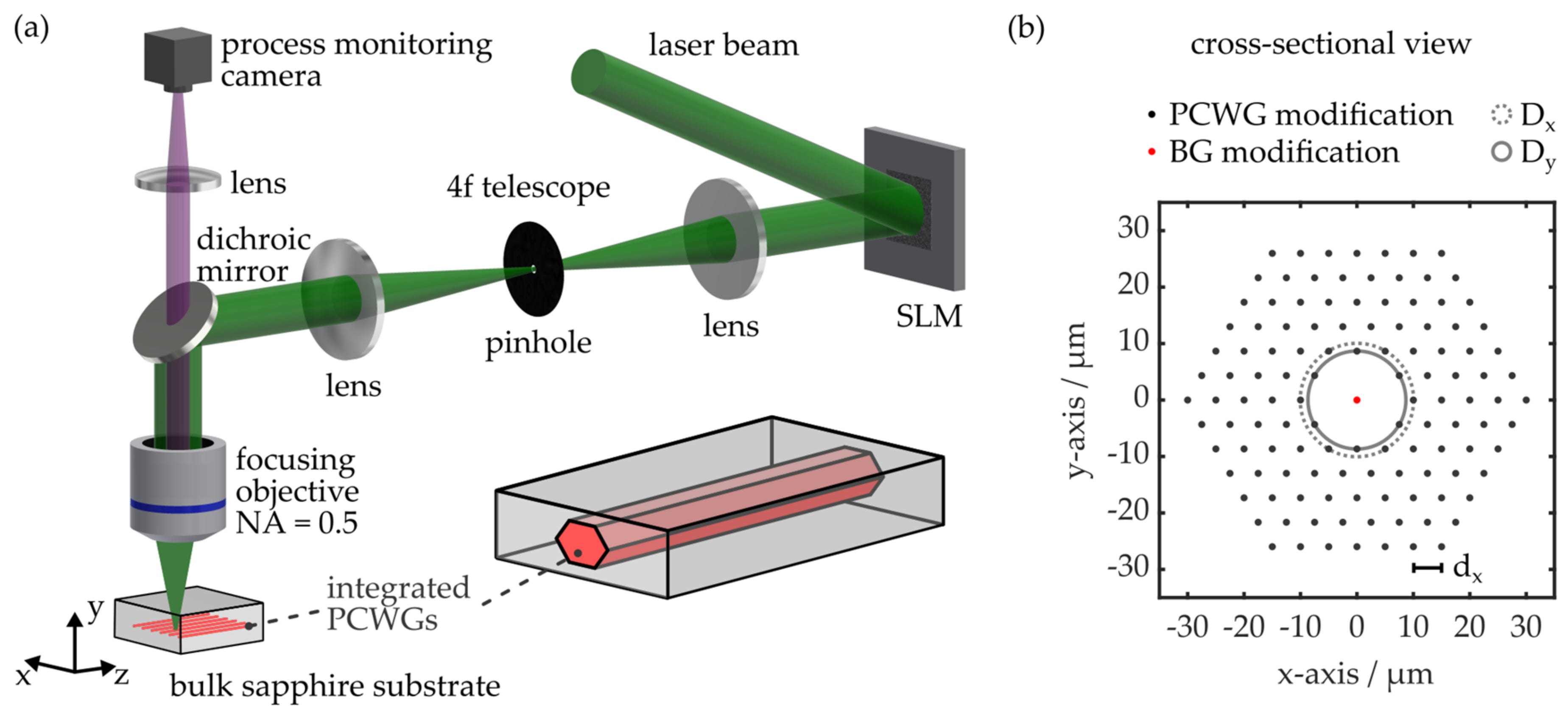
Previous approaches to creating single-mode or few-mode guidance in sapphire fiber have used femtosecond laser direct writing to create a depressed cladding waveguide: a ring of laser-modified tracks surrounding a central sapphire core, where the modification reduces the local refractive index and creates the index contrast needed for guidance. The approach works — single-mode guidance has been demonstrated, and temperature sensors based on Bragg gratings inscribed within these waveguides have been characterised up to temperatures approaching 1500°C. But depressed cladding fabrication is slow: each track in the ring must be written individually, the ring must be dense enough to confine the mode adequately, and the total number of laser passes required is large.
This is precisely the problem the new paper addresses.
Keep reading with a 7-day free trial
Subscribe to Precision with Light to keep reading this post and get 7 days of free access to the full post archives.