
Two Nobel Prizes, One Acquisition, and the Business Model That Actually Works in Ultrafast Lasers
Business of Photonics | Precision with Light. Co-written by/with Nuno Edgar Nunes Fernandes

Light Conversion just bought Class 5 Photonics. The deal tells you more about how to build a durable photonics company than a dozen business school case studies.
The Acquisition Nobody Saw Coming — But Everyone Should Have
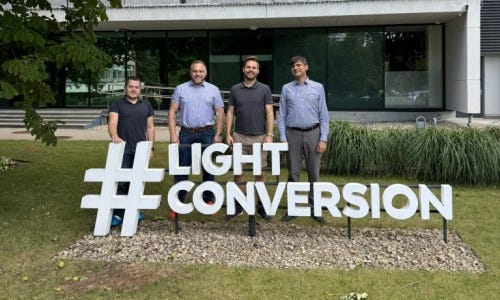
Last week, Light Conversion — a laser company headquartered in Vilnius, Lithuania, founded in 1992 as a direct spinout of research led by Professor Algis Petras Piskarskas at Vilnius University — announced the acquisition of Class 5 Photonics GmbH, a Hamburg-based ultrafast laser manufacturer that itself originated as a spinout from DESY, Germany’s national particle accelerator centre, and GSI, the heavy-ion research facility in Darmstadt.
No acquisition price was disclosed. Both companies are privately held. The industry press covered it briefly, noted the complementary technologies, and moved on.
This deal deserves a close reading — not because of its size, but because of what it reveals about the only business model that has consistently produced durable, technically credible companies in the ultrafast laser segment. The cooperation between the Lithuanian and German laser manufacturers is set to strengthen their market position as suppliers of advanced ultrafast technologies, connecting two companies shaped by similar scientific backgrounds and technology-driven approaches to business.
“Technology-driven approaches to business.” That phrase, from Light Conversion’s own press release, is either a platitude or a precise description of a specific strategic philosophy. In this case it is the latter — and understanding what it actually means separates the companies that have lasted in ultrafast photonics from the ones that have not.
What Each Company Built
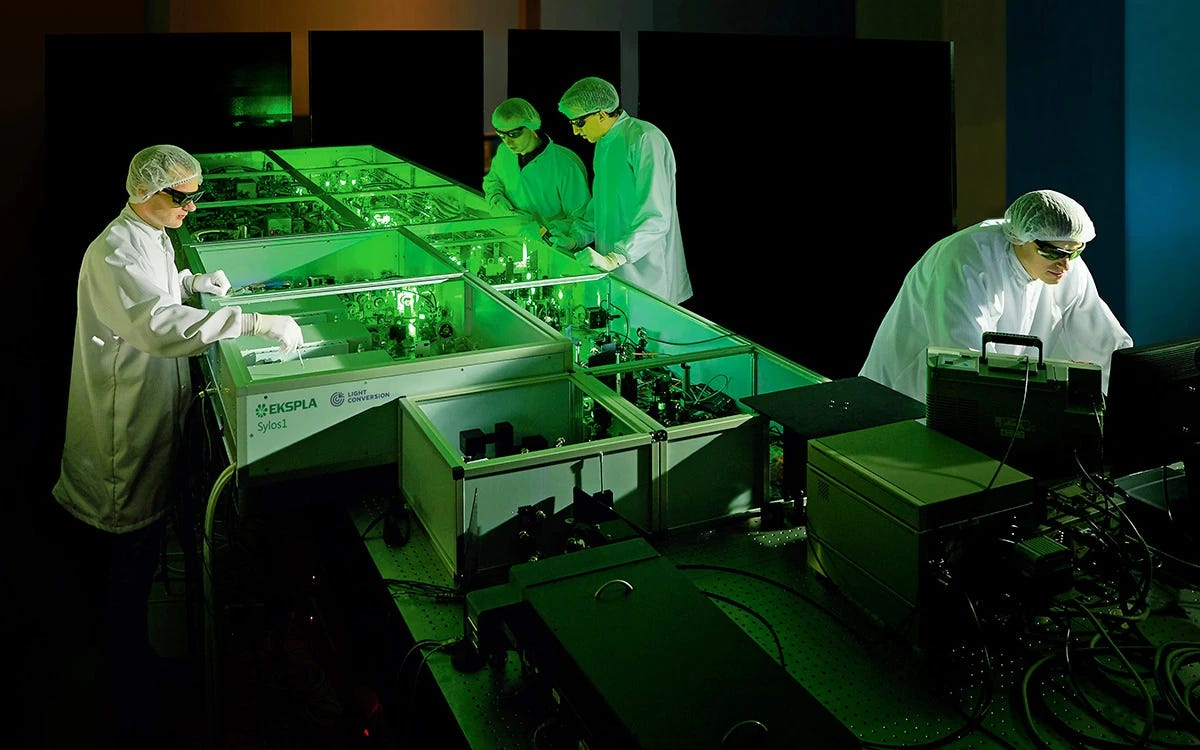
Light Conversion’s flagship product family is PHAROS — a femtosecond laser platform that has become the workhorse of scientific research groups worldwide — alongside TOPAS, an optical parametric amplifier that converts the PHAROS output to tunable wavelengths across the visible and infrared. Light Conversion was among the first companies to commercialise OPCPA-based technologies, introducing OPCPA (optical parametric chirped-pulse amplifiers) concepts into its OPA platforms in the early 2000s before launching complete OPCPA systems in 2014. The SYLOS systems built for the ELI-ALPS attosecond science facility in Hungary — some of the most powerful few-cycle laser systems ever constructed — came from Light Conversion in partnership with Ekspla.
Class 5 Photonics came from a different starting point but arrived at adjacent territory. After developing high-power OPCPA systems for extreme-ultraviolet synchrotron and free-electron laser applications, the founding team established the company in 2014 in Hamburg. Over more than a decade, Class 5 Photonics built expertise in the most powerful tunable OPCPA systems, ultrafast mid-infrared lasers and coherent EUV sources, including systems developed for attosecond science, ultrafast spectroscopy, and semiconductor-related EUV applications.
The overlap in OPCPA expertise is the obvious rationale for the deal. The non-obvious part is the Class 5 phrase that deserves to be read twice: “semiconductor-related EUV applications.” We will return to that.
The Nobel Prize Business Thesis
Awarded the Nobel Prize in Physics in 2018, chirped-pulse amplification has fundamentally transformed the field of ultrafast laser science and accelerated the broader adoption of these technologies in both research and industry over the past decade. Several years later, attosecond pulse generation was also recognised with the Nobel Prize, further increasing the demand for more powerful few-cycle lasers operating at longer wavelengths.
Two Nobel Prizes in ultrafast laser physics within five years. The 2018 prize — to Donna Strickland and Gérard Mourou for chirped-pulse amplification — validated and commercialised an entire technology family. The 2023 prize — to Pierre Agostini, Ferenc Krausz, and Anne L’Huillier for attosecond pulse generation — pointed to the next frontier and, in doing so, created demand for more capable systems.
In this context, OPCPA technology, driven by emerging 100-watt-class laser systems, has become an important approach for applications including attosecond science, high-field physics, particle acceleration, ultrafast spectroscopy, and bio-imaging.
This is the business logic hiding in plain sight: the Nobel Committee, with unusual consistency, has been validating the technology roadmap that Light Conversion and Class 5 Photonics have been building along for thirty years. That is either remarkable prescience or confirmation that both companies have been genuinely at the frontier — and the distinction matters enormously for how you evaluate the business.
The Model That Actually Works — and Why Most People Miss It
Here is the uncomfortable truth about the ultrafast laser market that the market research reports will not tell you, because it does not fit neatly into a CAGR (Compounded Annual Growth Rate) chart.
The ultrafast lasers industry shows moderate concentration; the top five vendors capture a major revenue share, leaving room for niche specialists to flourish. TRUMPF’s serial acquisitions stack source, optics, and automation know-how into end-to-end solutions that cut buyer integration risk. Coherent Corp. exploits AI-assisted adaptive optics that auto-correct beam distortions, locking customers into proprietary control software.
TRUMPF and Coherent are pursuing the standard industrial logic: consolidate, integrate, lock in. It works at scale. It produces defensible businesses with predictable revenue streams. And it almost always fails to produce the next generation of technology.
Light Conversion has spent thirty years doing something different. They have maintained genuine proximity to the scientific frontier — not as a marketing claim but as an operational discipline. Their product development is driven by what the best research groups in the world actually need next, rather than by what the largest addressable market segment will pay for at scale. That discipline is harder to maintain than it sounds, because the scientific market is small, the sales cycles are long, and the customers are demanding and technically savvy in ways that industrial buyers are not.
But proximity to the frontier produces something that volume-oriented laser companies consistently fail to generate: early access to the next application that becomes the next market. OPCPA was a research curiosity in the 1990s. It is now a $300 million annual segment and growing at 20%+ because attosecond science, high-field physics, and semiconductor metrology need it. Light Conversion was there when it was a curiosity, so they were positioned when it became a market.
Class 5 Photonics followed the same trajectory from a different starting point. DESY and GSI are not universities. They are large-scale scientific infrastructure — synchrotrons, free-electron lasers, heavy-ion accelerators — that operate at the absolute edge of what photonics hardware can do. A spinout from that environment does not build products for the mainstream market. It builds products for the hardest problems, which means it builds products that will eventually define the next mainstream market.
The EUV (Extreme-Ultraviolet Lithography) angle is where this gets genuinely interesting. Class 5's expertise in "semiconductor-related EUV applications" is a reference to coherent EUV generation — producing extreme ultraviolet light through high-harmonic generation, where an ultrafast infrared pulse is converted to EUV wavelengths in a noble gas jet. This is not the same EUV as ASML's lithography light source, but it is adjacent to it in a specific and significant way: EUV metrology and mask inspection for next-generation semiconductor lithography requires coherent, tunable EUV sources that ASML's plasma-based light source cannot provide. The ultrafast laser community has been building toward this gap for a decade.
Whether Light Conversion’s combined OPCPA capabilities will eventually address that semiconductor metrology market directly is not certain. What is certain is that acquiring Class 5 puts them in the conversation in a way that Light Conversion alone was not.
This is the business model that actually works in deeptech photonics, stated plainly: build the hardest products for the most demanding scientific customers, stay genuinely close to the frontier, be patient, and wait for the frontier to become the market. It is not a scalable formula for venture-backed growth. It is a formula for building a company that is still technically relevant in thirty years — which is a rarer achievement than any IPO.
The global ultrafast laser market was estimated at USD 2.45 billion in 2025 and is expected to reach USD 2.79 billion in 2026, with a compound annual growth rate of 21% from 2026 to 2033 to reach USD 10.6 billion by 2033. Within that trajectory, the scientific and advanced industrial segment — the territory Light Conversion and Class 5 occupy together — will grow faster than the average as Nobel Prize-validated applications move from research to deployment at scale.
The companies that will capture disproportionate value in that growth are the ones already at the frontier, already trusted by the scientific community, already holding the IP that the next wave of applications requires. By that measure, the Light Conversion acquisition of Class 5 Photonics is one of the most strategically sound moves in the ultrafast laser market this year — whatever the undisclosed acquisition price turns out to have been.
Nuno Edgar Nunes Fernandes Precision with Light | Business of Photonics precisionwithlight.substack.com