
The Invisible Junction: Inverse Design Solves the Waveguide Crossing Problem Across Two Centuries of Photonics
Research & Technology | Precision with Light. Co-written by Nuno Edgar Nunes Fernandes, 19th May 2026.

A Journal of Lightwave Technology paper from a Chinese team demonstrates record-performance inverse-designed waveguide crossings on silicon nitride — spanning visible to telecom wavelengths with loss so low it approaches the theoretical floor.
The Problem Seldom Talked About Enough
Every photonic integrated circuit of any complexity has them. Wherever two waveguide routes need to cross on the same layer of a chip — and in any non-trivial PIC routing topology, they will — there is a waveguide crossing. It is the photonic equivalent of a road intersection: two optical highways meeting at a point, each needing to continue on its way without depositing traffic into the other lane.
The problem is deceptively simple to state and genuinely difficult to solve. At a waveguide crossing, four things happen simultaneously and all of them are bad. Power from Waveguide A leaks into Waveguide B — crosstalk, which corrupts the signal. Power from both waveguides radiates into the substrate — insertion loss, which wastes optical power. The crossing introduces a small but non-negligible reflection back toward the source. And all three effects are wavelength-dependent, meaning a crossing optimised at 1550nm performs differently at 1310nm or at 640nm.
In a small photonic circuit with a handful of crossings, these effects are manageable. In a large-scale PIC — a quantum photonic processor with hundreds of Mach-Zehnder interferometers, a co-packaged optics switch with dozens of wavelength channels, a programmable photonic mesh with a full hexagonal routing fabric — crossings accumulate. A crossing with −0.5 dB insertion loss, unremarkable in isolation, contributes −50 dB of cumulative loss across a cascade of one hundred crossings. At that scale, crossing performance is not a second-order concern. It is a fundamental constraint on how large and how functional a photonic integrated circuit can be.
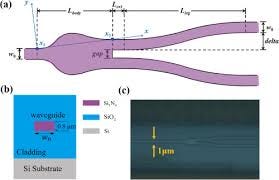
A paper published in Journal of Lightwave Technology in March 2026 — from Haoran Wang, Yan Fan, Liu Li, Ziyang Xiong, Zhichao Ye, Hao Deng, Shihua Chen, Tong Lin, Junpeng Lu, and Zhenhua Ni — addresses the waveguide crossing problem on the silicon nitride platform with a combination of inverse design methodology and fabrication-robust optimisation that sets new performance benchmarks across two separate wavelength bands simultaneously. The results are, by any reasonable measure, remarkable.
Why Silicon Nitride — Again
Regular readers of this publication will recognise Si₃N₄ (Silicon Nitride) as a recurring protagonist. The quantum photonic processor corpus — the QuiX Quantum 8×8 and 20-mode processors — is built on silicon nitride specifically because two-photon absorption eliminates silicon-on-insulator as a viable platform for single-photon quantum circuits. The Nature Communications inverse design paper from October 2025, already in the platform’s research corpus, demonstrated 1,200× footprint reductions in Si₃N₄ devices. The photonic tensor processor paper covered in the first standalone Research & Technology post used a Si₃N₄ microcomb as its light source.
The reason silicon nitride keeps appearing is structural. It is the platform that spans the widest useful wavelength range of any CMOS-compatible photonic material — from approximately 400nm in the visible through the entire telecom band (O through L, 1260–1625nm) and into the short-wave infrared beyond 2µm. Silicon-on-insulator becomes absorbing below approximately 1100nm, ruling it out for visible applications. Lithium niobate on insulator has excellent electro-optic properties but higher propagation loss and more demanding fabrication. Silicon nitride has no two-photon absorption at any wavelength relevant to classical or quantum photonics, propagation losses approaching 0.1 dB/m in the best demonstrated platforms, and full compatibility with standard CMOS photolithography.
That last point is what makes the Wang et al. paper’s result meaningful beyond its benchmark numbers. The crossing device was fabricated with standard photolithography at a 200nm minimum feature size — not electron-beam lithography, not deep-UV immersion at cutting-edge nodes, but a process accessible at any reasonably equipped Si₃N₄ foundry. Record performance with accessible fabrication is the combination that converts a laboratory demonstration into a component that can appear in production PICs.
Keep reading with a 7-day free trial
Subscribe to Precision with Light to keep reading this post and get 7 days of free access to the full post archives.