
POET Technologies and the Optical Interposer Bet: One Chip, One Investor, $400 Million
Created, co-written and edited by Nuno Edgar Nunes Fernandes | Business of Photonics | Precision with Light

The most technically ambitious financing in photonics this year just closed — and the Lumilens supply agreement hiding behind it tells you exactly what the bet is really about.
The Number Everyone Reported, and the Story Behind It
On May 18, 2026, POET Technologies (NASDAQ: POET) closed a $400 million registered direct offering to a single institutional investor — 19,047,620 common shares and an equal number of warrants at a combined price of $21.00, a premium over POET’s NASDAQ closing price of $20.57 on May 14. The warrants are exercisable at $26.25 for three years — a 25% premium over the offering price — which means the anonymous institutional investor structured the deal with a clear view on where POET’s share price is heading.
Most coverage stopped there. The $400 million headline is large enough to generate attention without requiring further analysis.
But the more interesting story closed four days earlier, and almost nobody led with it.
On May 14 — the same day that became the reference price for the offering — POET announced a supply and development agreement with Lumilens, a Silicon Valley photonics startup founded by veterans of Cisco, Juniper Networks, Meta, Lumentum, and Coherent, which is building next-generation photonic interconnects for AI infrastructure. The agreement includes an initial purchase order of $50 million and a framework for cumulative purchases of up to $500 million. The $400 million raise and the Lumilens agreement are not coincidences occurring in the same week. They are two components of the same strategic move.
What POET’s Optical Interposer Actually Does
Before the strategic analysis, the technology deserves a precise description — because “optical interposer” is a term that gets used loosely in the industry and POET’s implementation is specific.
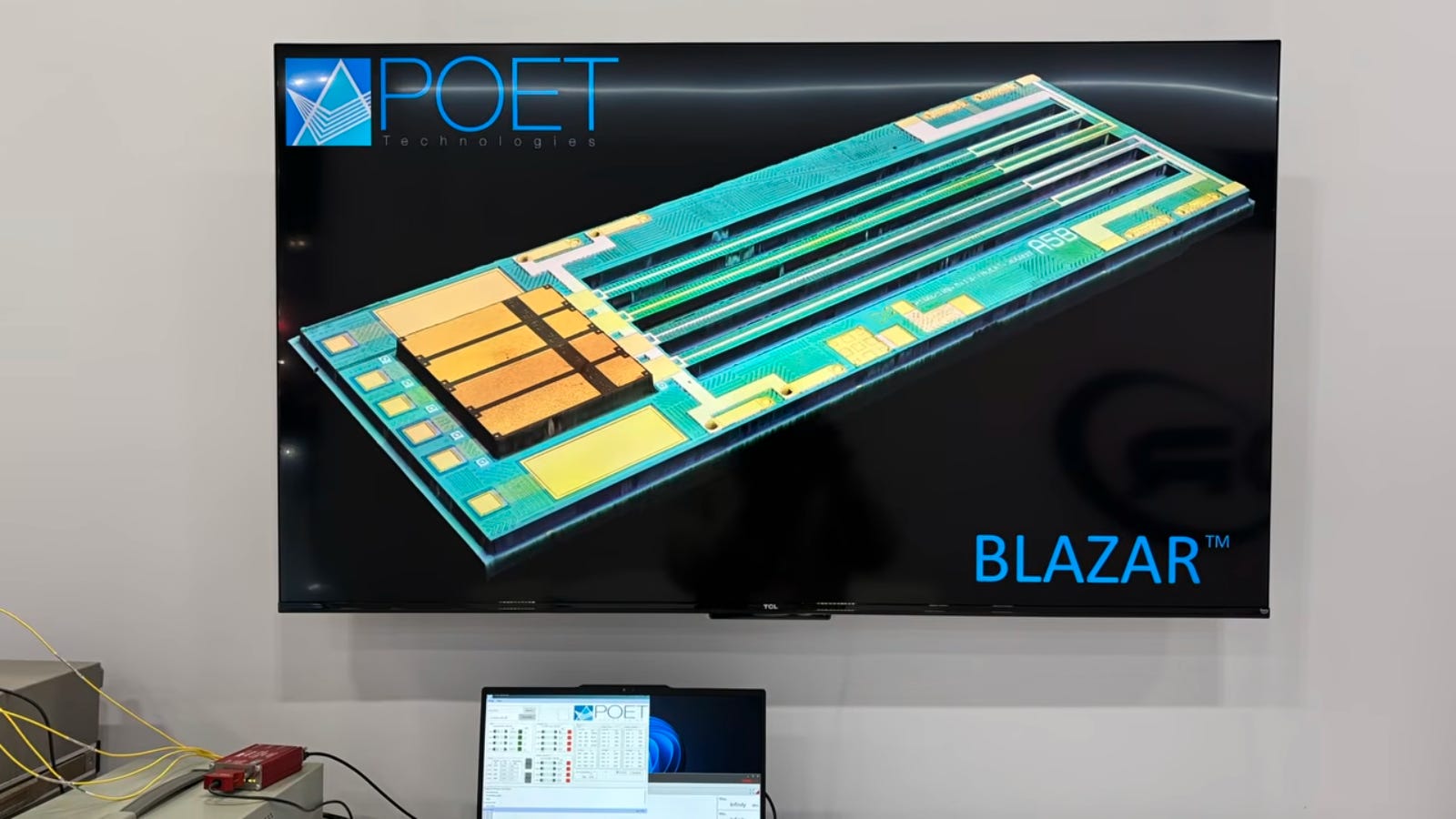
POET’s photonic integration solutions are based on the POET Optical Interposer — a novel, patented platform that allows the seamless integration of electronic and photonic devices into a single chip using advanced wafer-level semiconductor manufacturing techniques. POET’s Optical Interposer-based products are lower cost, consume less power than comparable products, are smaller in size and are readily scalable to high production volumes.
The key word in that description is “wafer-level.” Most silicon photonic transceivers today are assembled from multiple discrete components — laser dies, modulator chips, photodetector arrays — bonded together with active alignment under microscopy, a process that is accurate but slow and expensive at production volumes. POET’s approach moves the assembly to the wafer level: all components are placed and bonded at the wafer scale before dicing, using the same batch processing infrastructure that makes semiconductor manufacturing economical. The result is a chip-scale optical engine that integrates the laser, modulator, and detector in a single package, without active alignment.
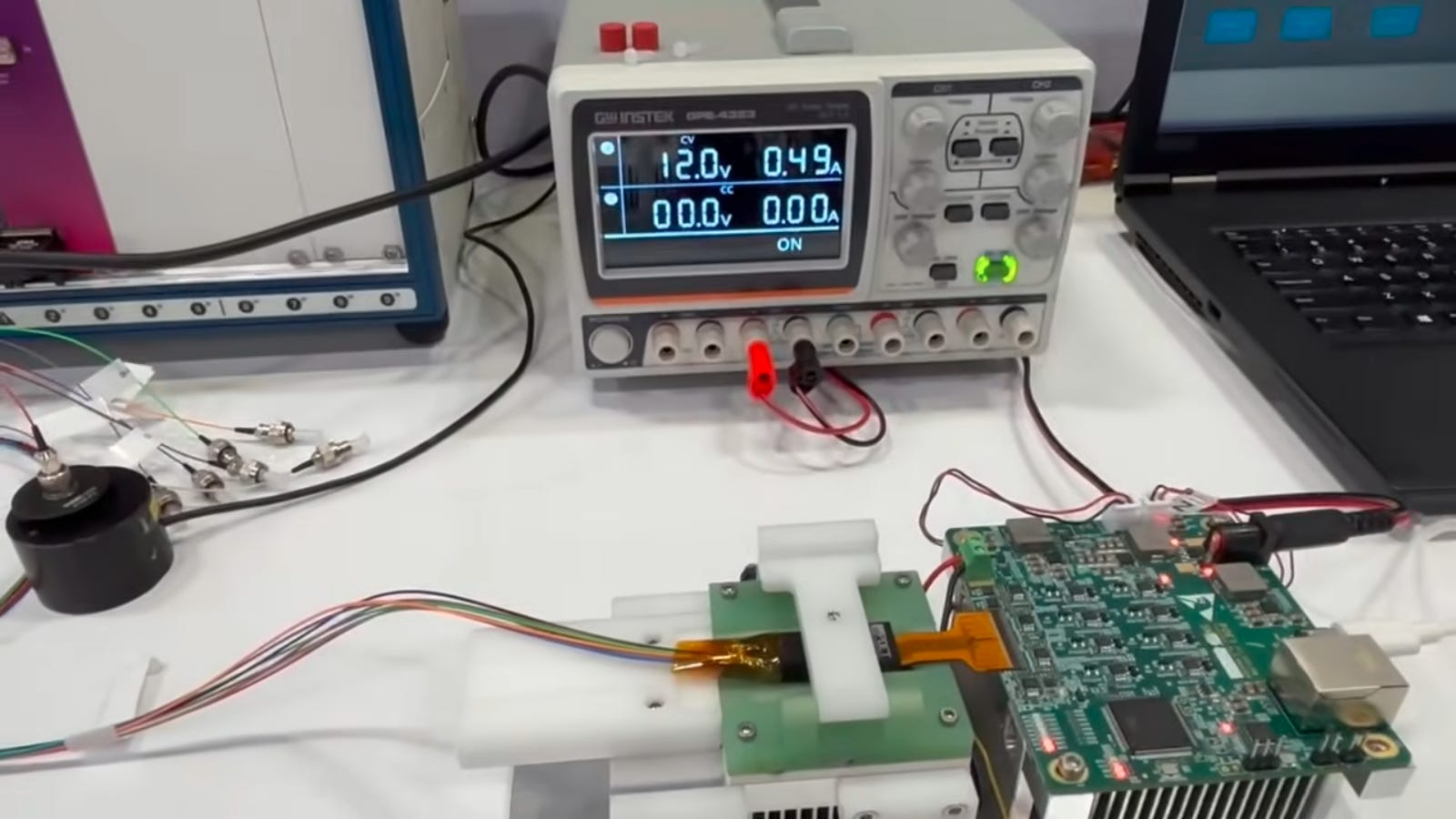
POET’s product portfolio addresses the full data rate roadmap: 800G, 1.6T and above optical engines and optical modules for AI clusters and hyperscale data centers. Beyond transceiver products, POET has designed novel light source products for chip-to-chip data communication within and between AI servers — what the industry calls “near-package optics” or “in-package optics” — targeting the next frontier of AI interconnect where the optical interface moves from the module cage to the chip package itself.
Multiple customer relationships with major manufacturing partners are already in place: Mitsubishi Electric, LuxshareTech, LITEON, Foxconn Interconnect Technology, and ADTRAN. These are not pilot programme relationships. They are production-oriented partnerships with companies that manufacture at scale.
The Lumilens Deal: Why It Matters More Than the $400M
Lumilens is a company that most readers of this publication will not have encountered before this week. It deserves a close reading, because its positioning reveals precisely what POET is being funded to build.
Lumilens describes its mission as bringing “the speed of light to AI” by providing next-generation photonic interconnects for massively scaling out and scaling up AI compute infrastructure. Its founding team brings experience from Cisco, Juniper, Meta, Lumentum, and Coherent — the full stack of networking, systems, and photonics expertise required to build credible AI infrastructure products.
The distinction Lumilens draws between scale-out and scale-up architectures is important and worth stating precisely. Scale-out networking connects GPU clusters to each other across rack-to-rack and pod-to-pod distances — the standard Ethernet fabric where 800G transceivers, CPO switches, and the Lumentum/Coherent supply chain we have covered in previous editions operate. Scale-up networking connects GPUs directly to each other within a training cluster — the NVLink and InfiniBand domain where NVIDIA’s Quantum-X800 switches and the tightest latency requirements live.
Lumilens claims to be the only photonics vendor that enables both cluster-to-cluster and direct GPU-to-GPU architectures from a single supplier — 100× higher density GPU-to-GPU connections than existing solutions, with GPU disaggregation to achieve massive scale and mitigate power density issues. These are aggressive claims for a company that is not yet shipping at volume. But the $50 million initial purchase order — with a $500 million cumulative framework — suggests at minimum one large buyer believes the claims are credible enough to make a significant financial commitment.
The structure of the Lumilens agreement places POET at the supply foundation of that ambition. The initial $50 million order and the framework tied to as much as $500 million in cumulative purchases give POET Technologies clearer volume goals, but fulfilment depends on successful product qualification and high volume manufacturing by 2027. That last clause is the honest caveat: the $500 million framework is conditional on POET executing a manufacturing scale-up that it has not yet completed.
The $400 Million: What It Is Actually Buying
The company plans to deploy the proceeds to expand manufacturing capacity roughly ten-fold in wafer production and optical engine assembly, accelerate R&D and its light source business, and pursue targeted acquisitions and partnerships.
A ten-fold expansion in wafer production capacity is the operational core of this raise. POET’s current manufacturing footprint is not configured for the volumes implied by the Lumilens framework or by the broader AI transceiver demand trajectory. The $400 million is the capital required to bridge from current production capability to the scale required to fulfil the committed order backlog and the framework agreements simultaneously.
The deal structure is worth examining for what it reveals about investor confidence and risk allocation. The offering was completed under an automatic shelf registration statement on Form F-3 that became effective on January 22, 2026. The company issued 19,047,620 common shares along with warrants exercisable for an additional 19,047,620 common shares. The single-investor structure — one institutional buyer taking the entire $400 million — is unusual for a public company raise of this size. It signals either very high conviction from that investor, a specific strategic relationship beyond pure financial investment, or both. The identity of the investor has not been publicly disclosed, which is permitted under a registered direct offering structure but leaves a meaningful question open for the market.
The warrant structure adds further complexity. If the investor exercises the full warrant tranche at $26.25, POET will have raised an additional $500 million — bringing total proceeds to $900 million — but at the cost of significant dilution to existing shareholders. The warrant package for Lumilens and the separate $400 million follow-on equity offering both point to meaningful potential dilution on top of an early stage revenue base of $0.5 million. That $0.5 million revenue figure is the critical number that contextualises the entire transaction: POET is raising $400 million on an essentially pre-revenue base, financing a manufacturing scale-up that must be completed before the Lumilens framework can generate significant revenue.
The Honest Assessment: Promise and Risk
Reading the full picture — the Optical Interposer technology, the Lumilens supply agreement, the $400 million raise, the manufacturing scale-up plan — the POET story is simultaneously one of the most technically compelling and one of the most financially risky in the photonics sector right now.
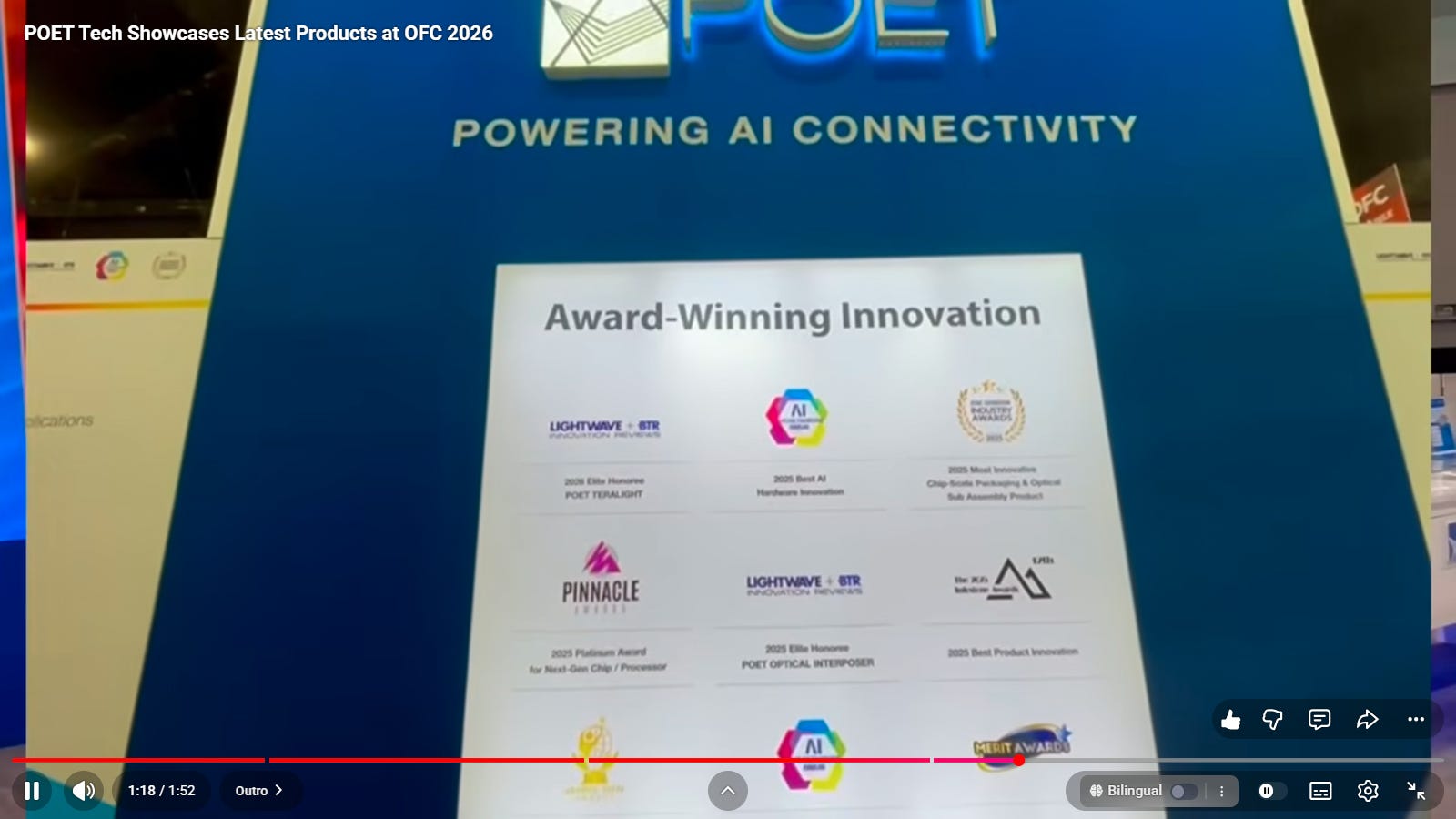
The technical proposition is real and differentiated. Wafer-level integration of photonic and electronic components, without active alignment, at 800G and 1.6T data rates, with a product roadmap extending to chip-to-chip optical interconnects for AI servers — this addresses a genuine bottleneck in the AI infrastructure buildout. The customer relationships with Mitsubishi, Foxconn, LuxshareTech, and now Lumilens are not trivial. Multiple award wins in 2024 and 2025 for AI hardware innovation from independent technical bodies add credibility.
The financial risk is equally real. A $0.5 million revenue base against a $400 million raise implies an execution requirement — complete a ten-fold manufacturing scale-up, qualify products with multiple customers simultaneously, and begin shipping against committed purchase orders, all within an 18-month window — that is aggressive by any standard. The single-investor structure for the raise, while not inherently problematic, means the company’s financial trajectory is now substantially dependent on one undisclosed institutional relationship.
The contrast with the consolidation stories covered in previous editions of this track is instructive. The Credo/DustPhotonics acquisition was $1.3 billion for a company with production-deployed technology and existing hyperscale customer relationships. Lumentum’s $2 billion NVIDIA investment was for a company already shipping supply-constrained EML lasers at scale. POET’s $400 million is for a company building toward those positions, not yet occupying them.
That distinction does not diminish the significance of the transaction. In a market where photonics hardware is becoming AI infrastructure, the companies that secure the capital to scale manufacturing before demand fully materialises will be positioned to capture the market when it does. The question is whether POET’s execution capability matches the ambition of its financing.
The Lumilens framework — up to $500 million in cumulative purchases — is the answer POET needs to provide. Not in press releases, but in quarterly revenue figures, starting in 2027.
Nuno Edgar Nunes Fernandes Precision with Light | Business of Photonics precisionwithlight.substack.com