
Photonics Is Now Inside the GPU — And Inside the Drone
Business of Photonics | Precision with Light. Co-written with and platform original idea and early development by Nuno Edgar Nunes Fernandes.

Lightmatter joins NVIDIA NVLink Fusion today from Taipei. A$100M Arkeus raises A$25M for hyperspectral defence sensing. Two stories, one structural shift.
The Announcement That Changes the AI Infrastructure Map
This morning, from Taipei at COMPUTEX — timed deliberately alongside Jensen Huang’s keynote — Lightmatter announced it has joined the NVIDIA NVLink Fusion ecosystem.
Read that sentence carefully, because it matters more than it appears. NVLink is not Spectrum-X. NVLink is not a data center fabric switch. NVLink is the scale-up interconnect that binds GPUs to each other directly — the copper backbone of NVIDIA’s GB200 NVL72 systems delivering over one petabit per second of bandwidth within a single rack.
Until today, NVLink has been entirely copper. Through this collaboration, Lightmatter will deliver Co-Packaged Optics (CPO) and Near-Packaged Optics (NPO) products compatible with NVIDIA’s optical and SerDes technologies. That is photonics inside the scale-up interconnect — not just the scale-out fabric. The boundary between electrical and optical in AI computing infrastructure has just moved.
Lightmatter’s groundbreaking Passage® platform — the world’s first 3D-stacked silicon photonics engine — and Guide® — the industry’s first VLSP™ light engine — connect thousands to millions of processors. The Passage M1000, their current reference platform, sits as an active 3D interposer directly beneath the GPU — 4,000mm², 1,024 serial channels at 56 Gbps each, delivering over 57 terabits of photonic bandwidth. The commercial product timeline is late 2027 announcement, 2028 availability.


The 650 Group analyst reading (which appears in the Lightmatter Press Release above) of this is worth quoting directly: “By making its Passage 3D photonic roadmap compatible with NVIDIA’s high-speed interconnect, Lightmatter is significantly expanding the addressable market for its CPO products. This partnership provides a validated blueprint for hyperscalers to overcome traditional I/O bottlenecks and scale AI clusters to the levels required for next-generation intelligence.”
That is the business statement. We will come back to what it actually means after the second story.
The Other Side of the World: A$100M Sensing Startup Raises A$25M
On May 15, Arkeus — an Australian sensing company — raised A$25 million in a Series A funding round to accelerate the development and global deployment of its AI-powered sensing systems for autonomous platforms. The round was led by QIC Ventures, with participation from R+ VC, Folklore Ventures and DYNE Ventures, alongside continued support from Main Sequence, Salus Ventures and Beaten Zone Venture Partners.
Arkeus builds AI-powered sensing systems that act as the “eyes and brain” of autonomous platforms, enabling machines to see, understand and act in real time — even in degraded, denied or disrupted environments. Arkeus produce and deploy wide-area search, intelligence, surveillance and reconnaissance capabilities across air, land and maritime domains.
The valuation — A$100 million, implied by the Forbes coverage — makes this a pre-revenue or early-revenue defence technology company being priced on roadmap and market positioning rather than current cash flows. The investor mix is instructive: QIC Ventures is a Queensland government-linked vehicle, Main Sequence is CSIRO’s deep-tech fund, and Beaten Zone is a specialist defence venture firm. This is sovereign capability investment, not pure commercial speculation.
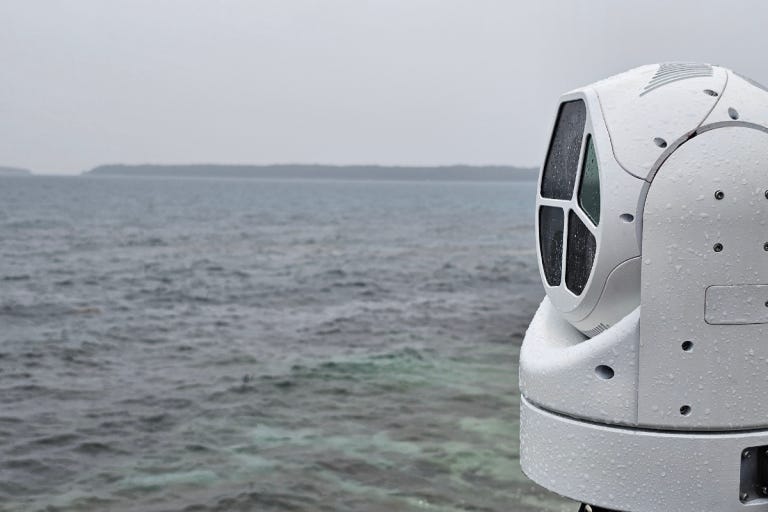
The capital will be used to accelerate global expansion, establish advanced manufacturing capability in Queensland and the United States, and deliver Arkeus systems into operational use faster across allied defence markets. “Allied defence markets” means Five Eyes — Australia, the US, the UK, Canada, New Zealand — which is the commercial aperture that makes an Australian defence startup internationally viable rather than domestically constrained.
The hyperspectral imaging angle, covered in the Forbes article, is the technology that connects this to the broader photonics story. Hyperspectral sensors capture dozens to hundreds of narrow spectral bands simultaneously — not the three broad colour channels of a camera, but a full spectral fingerprint of every pixel in the image. The combination of hyperspectral imaging with AI inference at the edge — onboard the drone, in real time, without a communications link back to a human analyst — is precisely what Arkeus is building.
The Structural Shift Both Stories Are Describing
Two companies. Two announcements within three weeks. One in silicon photonics computing infrastructure at hyperscale. One in hyperspectral optical sensing for autonomous military platforms at the tactical edge.
The temptation is to treat these as separate market stories. They are not.
Both are expressions of a single structural transition: photonics moving from a specialist technology confined to data transmission into the active computational and sensing fabric of AI systems at every scale. In the data center, photonics is replacing copper at the GPU interface — moving from the faceplate of a switch to the surface of a package to, with Lightmatter, the interposer beneath the GPU itself. At the tactical edge, photonics is replacing narrow-band cameras with spectrally rich sensing systems whose output is designed from the ground up for machine interpretation rather than human viewing.
The Lightmatter story is well-understood in the photonics industry because it follows the CPO narrative this publication has been tracking since March. What is less understood is what the NVLink Fusion partnership specifically signals beyond the CPO mainstream.
NVLink is NVIDIA’s proprietary scale-up interconnect. It is not an open standard. Joining the NVLink Fusion ecosystem is not the same as joining a standards body or qualifying a component for a commoditised market. It means Lightmatter’s Passage platform is being designed into NVIDIA’s next-generation system architecture — the one that will power the Vera Rubin generation and beyond. Products announced in late 2027, available 2028. That timeline is close enough to be credible and far enough away to require genuine execution.
The risk in the Lightmatter story is not technical. The Passage platform is real, demonstrated, and technically differentiated — 3D stacking of silicon photonics beneath the GPU is an architectural innovation with no equivalent in the market. The risk is the standard deeptech timing risk: customer systems are designed two to three years ahead of volume shipments, and a partnership announced today does not generate revenue until the product ships and the customer qualifies it. Between announcement and revenue, things can go wrong in ways that have nothing to do with whether the photonics works.
The Arkeus story is less straightforward and in some ways more interesting precisely because the technology is less mature and the market is less defined.
Hyperspectral sensing for autonomous platforms has been a research and defence-program topic for over a decade without producing a commercially scaled company. The reasons are familiar to anyone who has watched deeptech defence companies: the sensors are heavy, power-hungry, and expensive; the data volumes are enormous; the processing requirements exceed what edge compute has historically been able to provide; and the defence procurement cycle rewards established primes over innovative startups. Every one of those constraints has loosened in the past three years. Sensor miniaturisation has accelerated. Edge AI accelerators (the same silicon photonic interconnect story, applied to inference chips rather than GPUs) have brought the compute to the platform. And defence procurement in Australia, the US and the UK has explicitly opened to non-traditional vendors under programs like AUKUS’s Pillar II advanced capabilities work.
Arkeus is Australian. Its manufacturing is planned for Queensland and the United States. Its investors include a Queensland government fund and CSIRO’s venture arm. This is deliberate sovereign positioning — building the manufacturing capability for a critical military sensor system within allied national borders at a moment when supply chain sovereignty is a genuine procurement criterion. The ISO 9001 certification, achieved just three weeks after the Series A closed, signals that the company is moving aggressively toward the quality management standards required for defence contracting.
The valuation at A$100 million on A$25 million raised implies investors are pricing a significant probability that Arkeus becomes a meaningful supplier to defence platforms across the Five Eyes alliance. That is a bet on both the technology and the procurement environment. The procurement environment has rarely been more favourable for a company with Arkeus’s profile.
What connects Lightmatter and Arkeus — beyond the photonics — is that both are building systems where the optical performance specification is driven by what the AI needs from the photonics, not by what the photonics can currently provide. Lightmatter’s Passage is designed around the bandwidth requirements of GPU-to-GPU communication at Rubin-generation data rates. Arkeus’s hyperspectral system is designed around the spectral resolution and spatial coverage required for AI-based target classification in complex terrain. In both cases, the photonic system is being specified from the application layer down rather than from the technology layer up.
That inversion — AI requirements driving photonic design rather than photonic capability constraining AI — is the structural change. It means the photonic design problem becomes harder, more constrained, and more valuable. Which is exactly where a physics-informed generative design platform belongs.
Next Tuesday: Research & Technology — first instalment of the Precision with Light arXiv paper draft process. Next Thursday: Business of Photonics continues.
Nuno Edgar Nunes Fernandes Precision with Light | Business of Photonics precisionwithlight.substack.com