
How a Single Coupler Connects Fiber Optics and Silicon Photonics: waveguide adiabatic coupling, on-chip, optical fiber to silicon nanophotonics
Research & Technology Edition | Precision with Light by Nuno Edgar Nunes Fernandes

A new paper from AIP Advances solves one of the most persistent engineering bottlenecks at the boundary between the world of glass fibers and the world of nanophotonic chips — and it does it with elegant simplicity.
The Most Expensive Millimetre in Photonics
If you have been following this publication from its earliest posts, you know that the platform we are building has two conceptual pillars. The first is the world of specialty optical fibers — large mode area designs, hollow-core photonic crystal fibers, anti-resonant waveguides. The second is the world of silicon photonics — nanoscale waveguides, ring modulators, programmable meshes, quantum photonic processors on chip. These two worlds were covered separately in the founding series because they are physically and technologically distinct domains.
But they are not isolated. Every time a silicon photonic chip needs to send or receive light from the outside world — from a laser source, from a sensing environment, from a quantum network, from a data center fiber link — it must interface with an optical fiber. And that interface, that single millimetre where light must transfer from a 10-micron fiber mode to a 300-nanometer silicon waveguide mode, is one of the most persistently difficult engineering problems in integrated photonics.
It is the problem that a paper published April 15th 2026 in AIP Advances, from Xinchao Zhou, Tzu-Han Chang, Eric Liu, Saivirinchi Prabandhakavi, and Chen-Lung Hung, addresses with a design that is notable for combining high performance with genuine fabrication simplicity. The title — “On-chip optical fiber-to-nanophotonic waveguide adiabatic coupler” — is technically precise to the point of being deliberately understated. What it describes is a solution to a problem that has constrained the practical deployment of nanophotonic systems for over two decades.
Why the Interface Is So Hard
To understand what makes this paper’s contribution meaningful, it helps to appreciate the scale of the problem it is solving.
A standard single-mode optical fiber — the kind that carries data across continents and connects data center racks — has a mode field diameter of approximately 10 micrometres at 1550nm wavelength. The optical field is relatively large, slowly varying, and well-matched to the gaussian beam profile of most free-space optics.
A silicon nanophotonic waveguide — the kind that routes light on a silicon photonic chip — has a cross-section of roughly 450nm × 220nm. The mode is tightly confined, with dimensions smaller than the wavelength of the light it carries, and the refractive index contrast between silicon (n ≈ 3.47) and its oxide cladding (n ≈ 1.44) is enormous by optical standards.
The mode field diameter mismatch between these two structures is approximately 30:1 in linear dimension, or roughly 1000:1 in area. Attempting to couple light directly from fiber to chip at an abrupt interface loses the vast majority of the optical power to radiation. This is not an imperfection in the manufacturing — it is a fundamental consequence of trying to couple two structures with modes of completely different spatial scales.
Three engineering approaches have been developed over the decades to manage this mismatch. End-fiber coupling, diffraction grating-based coupling, and adiabatic coupling each operate on different physical principles and involve different practical trade-offs. Grating couplers are by far the most commonly used — they are fabricated directly on the chip surface, require only vertical illumination from an optical fiber held above the chip, and are straightforward to integrate into standard PDKs. But grating couplers have limited optical bandwidth and are naturally out-of-plane, which creates both wavelength selectivity constraints and packaging complexity for edge-connected systems.
Adiabatic coupling is the physically elegant alternative. In adiabatic mode transfer, single-mode fiber-waveguide coupling efficiencies as high as 97% are achievable. Efficient coupling is obtained for a wide range of device geometries which are either singly-clamped on a chip or attached to the fiber, demonstrating a promising approach for integrated nanophotonic circuits, quantum optical and nanoscale sensing applications.
The word “adiabatic” here is borrowed from thermodynamics but applied to optics: a transformation is adiabatic if it happens slowly enough that the system remains in its fundamental mode throughout. In an adiabatic coupler, both the fiber and the waveguide are tapered — one getting narrower, the other getting wider — over a sufficient length that the optical mode transitions smoothly from one structure to the other without exciting higher-order modes or radiation modes. No abrupt interface. No mode mismatch loss. Just a gentle, gradual handover of the optical field.
The challenge with adiabatic couplers has always been fabrication. The problem of fiber-to-chip coupling is difficult because the fundamental mode of an optical fiber is roughly 10 µm in diameter, and the dimensions of the fundamental mode of a high-index-contrast waveguide are often less than 1 µm across. Earlier demonstrations of adiabatic coupling required either substrate releasing — a delicate microfabrication step that suspends the waveguide in air to prevent light leakage into the substrate — or cladding the tapered fiber tip in a higher-index polymer material to prevent the field from leaking before it reaches the chip waveguide. Both approaches add fabrication complexity and reduce yield.
What the New Design Actually Does
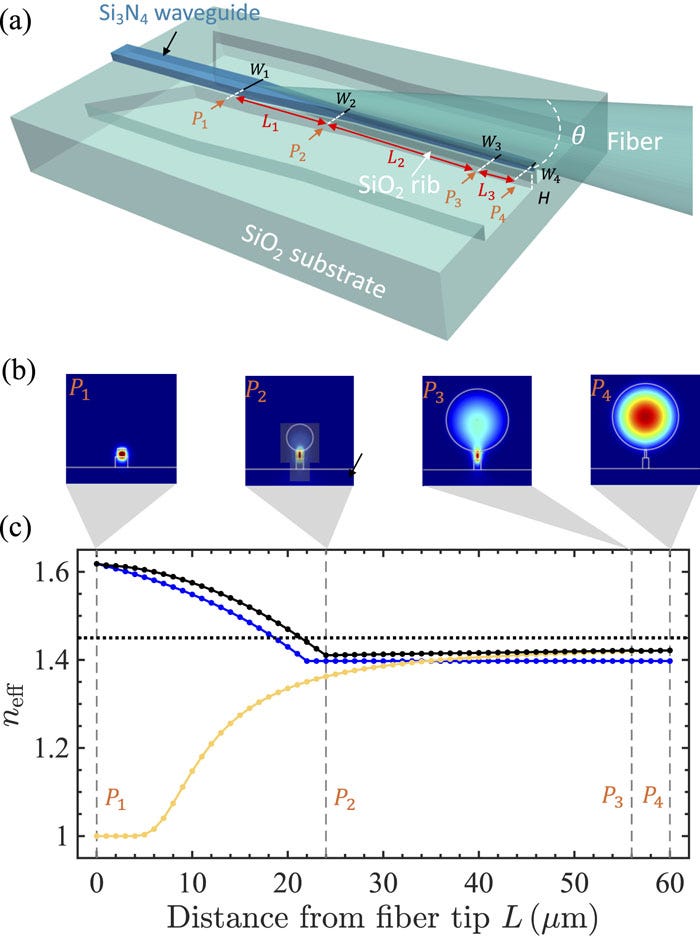
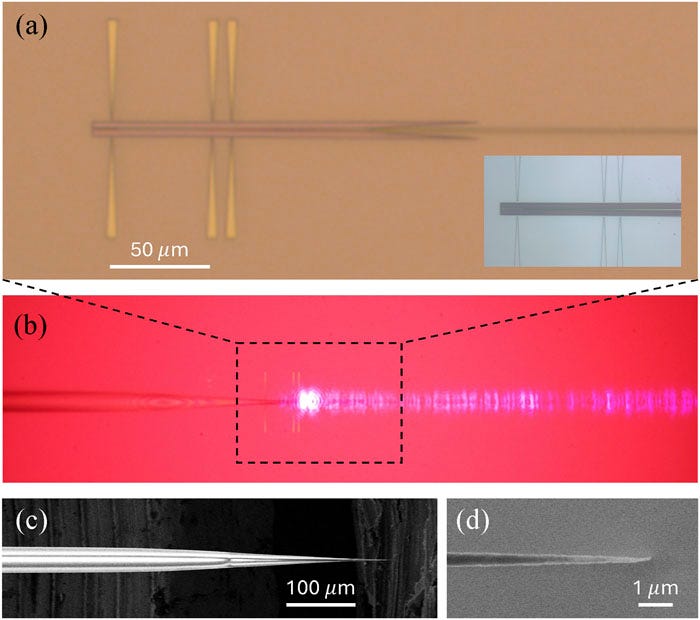
The AIP Advances paper reports a simple design of an on-chip fiber-to-nanophotonic waveguide adiabatic coupler. An inverse-tapered waveguide can be fabricated on an etched oxide layer to achieve index-crossing with a tapered optical fiber without severe light leakage into the substrate. The design involves simple fabrication steps without substrate releasing and does not rely on cladding the tapered fiber in a higher-index material.
The key innovation is the combination of two elements that have individually appeared in the literature but not been combined in this specific way. The first is the inverse taper on the chip side — a waveguide that deliberately narrows toward the fiber interface, reducing its effective index until it matches the effective index of the tapered fiber at the coupling point. The second is the etched oxide layer that creates a local region where the waveguide is suspended above a lower-index medium, preventing the evanescent tail of the guided mode from leaking into the substrate during the index-crossing event.
The index-crossing condition is the physical heart of the design. As the chip waveguide tapers down and the fiber tapers down simultaneously, there is a specific geometric point — a crossover — where the effective index of the chip mode and the effective index of the fiber mode become equal. At this point, the modes are phase-matched, and adiabatic power transfer from fiber to chip occurs naturally. The etched oxide ensures that this crossover happens cleanly, without the substrate acting as a lossy competing waveguide that steals power during the transition.
The simulated transmission efficiency reaches beyond 95% (−0.2 dB) with robust alignment tolerance for quasi-transverse magnetic polarization. The coupler shows reasonably wide bandwidth and high coupling efficiency for both fundamental quasi-TM and quasi-TE polarizations.
−0.2 dB insertion loss is an exceptional result. For context: state-of-the-art grating couplers typically achieve −1.5 dB at their peak wavelength. Standard edge couplers with lensed fibers achieve approximately −1.1 dB. The silicon chip is fabricated at a commercial foundry and then post-processed to release the tapering nanowires in some competing designs — a process step that this paper explicitly eliminates. The result is a coupling efficiency that rivals the best demonstrated adiabatic couplers, achieved with a fabrication process that is compatible with standard silicon photonic foundry workflows.
The alignment tolerance is the other critical metric. Any fiber-to-chip coupling scheme that requires sub-micron alignment precision becomes expensive to package at production scale — each chip requires active alignment under illumination, consuming operator time and specialised equipment. Adiabatic couplers are conducive to high-bandwidth, low-loss operation because neither mode matching nor k-vector matching at an abrupt interface occurs, so loss can be low across a broad bandwidth without high sensitivity to position. The AIP Advances design inherits this alignment robustness by design.
The Platform Connection — Why This Paper Matters Here
The coupling problem this paper solves sits at the exact boundary between the two technology domains that the Precision with Light platform is designed to bridge.
Every silicon photonic design that leaves this platform — every inverse-designed waveguide, every optimised ring modulator, every quantum photonic processor layout — eventually needs to connect to the outside world through an optical fiber. The coupler is not an afterthought in the PIC design flow. It is a first-class component that must be co-designed with the rest of the circuit, because its mode profile at the chip interface constrains the waveguide geometry on chip, and its taper length and oxide etch depth must be compatible with the foundry PDK.
For the platform specifically, this paper establishes three design parameters that belong in the fabrication constraint database for any edge-coupled silicon photonic design:
The inverse taper tip width — the narrowest point of the on-chip waveguide at the coupling interface — is the critical dimension that determines whether the effective index crossing condition is met. For a 220nm SOI platform, this tip width typically falls in the range of 80–150nm, which is at or below the resolution limit of standard 193nm deep-UV lithography. This is a hard DRC constraint that the DSR-CRAG system must enforce: a generated waveguide design that proposes a taper tip narrower than the foundry’s minimum printable feature fails before simulation.
The oxide etch depth — the thickness of silicon dioxide removed beneath the inverse taper to create the suspended region — is a process parameter that varies between foundries and imposes a constraint on the waveguide height above substrate during the coupling transition. This parameter connects the optical design directly to the process chemistry, which is precisely the kind of cross-layer constraint that the platform’s multi-level PINN framework is designed to propagate.
The coupling length — the distance over which the adiabatic transition occurs — is the design parameter that trades off device footprint against coupling efficiency and bandwidth. Shorter coupling lengths are more compact but less adiabatic, introducing mode conversion loss. For a co-packaged optics PIC where chip area is at a premium, the coupling length is an optimisation variable, not a fixed parameter. This is exactly the kind of multi-objective problem — minimise footprint, maximise efficiency, maintain bandwidth — where inverse design outperforms manual parameter sweeps.
The Broader Picture: Fiber Meets Silicon
This paper is in one sense a very specific technical contribution — a coupler design, simulated to 95% efficiency, with a simplified fabrication process. In another sense it is a data point in a larger story that this publication has been tracking.
The history of photonics over the past three decades can be read as a progressive integration of functions that were once performed by discrete fiber components — lasers, amplifiers, modulators, splitters, sensors — onto silicon photonic chips. Each integration step has required solving the same fundamental problem at smaller scale: how do you get light from the world of glass into the world of silicon, and back again, without losing it at the boundary?
The adiabatic coupler is one answer to that question, and this paper advances it meaningfully. But the deeper implication is that the boundary between fiber photonics and silicon photonics is not a wall — it is an interface, and interfaces can be engineered. The platform we are building treats fiber design and silicon photonic design as two modules of the same system, connected through exactly the kind of coupler that this paper describes.
When a user of the platform specifies “I need a silicon photonic gas sensor operating at 2 microns, fiber-coupled, with less than 0.5 dB total coupling loss,” the design problem spans both domains simultaneously: the PCF fiber design delivering the probe light, the edge coupler translating it from the fiber mode to the chip mode, and the on-chip waveguide routing it to the sensing region. None of those three components can be designed independently. The coupler is the connecting tissue.
Papers like this one are the building blocks of that integrated design capability.
We just end by displaying here the Conclusions paragraph we can read in the paper, which validates our points in the author’s own language:
In summary, we present a simple design and fabrication study of an on-chip tapered optical fiber-to-nanophotonic waveguide adiabatic coupler. The coupling efficiency, estimated via an FDTD simulation, could already reach 95% transmission for the fundamental quasi-TM mode without exhaustive search of optimal geometric parameters. The adiabatic coupler is expected to be broadband with less than a 3 dB drop for 300 nm around the design wavelength. The design features high coupling efficiency also for quasi-TE polarization. We investigate the effect of substrate etching and find that the resulting design achieves high coupling efficiency at the target wavelength. The key principle is to engineer a refractive-index crossing to satisfy the adiabatic condition. We believe that this design approach can be readily adapted to integrated photonic platforms coupled with other quantum emitters of nearby transition wavelengths, such as quantum dots and defect color centers.
Paper reference: Zhou, X., Chang, T.-H., Liu, E., Prabandhakavi, S., & Hung, C.-L., "On-chip optical fiber-to-nanophotonic waveguide adiabatic coupler," AIP Advances 16, 045315 (2026). → https://doi.org/10.1063/5.0322573
Nuno Edgar Nunes Fernandes Precision with Light precisionwithlight.substack.com · GitHub